Practical Experiences with OpenStack on OpenShift - DevConf.CZ 2025
A month ago I had the pleasure of returning to Brno to speak at DevConf.CZ 2025. This conference has a special place in my heart: it’s a fantastic community event where you can feel the passion for open source in every conversation.
When my colleague Sven and I were assigned to a new customer project at the start of the year, we were quite skeptical about deploying the latest version of Red Hat OpenStack, which uses a completely new, container-based methodology. Why would you put one complex distributed system (OpenStack) on top of another (OpenShift)? This certainly felt like building the tower of Babylon.

In our presentation, we shared our journey of discovery, moving from that initial skepticism to becoming advocates for this new architecture. We learned that treating the OpenStack control plane as just another set of microservices is precisely what Kubernetes was designed for, and the benefits are massive.
The talk dives into the architecture and our hands-on experience with Red Hat OpenStack on OpenShift (RHOSO), covering:
- The “Why”: We started by comparing the traditional architecture with the new RHOSO model, where OpenShift runs directly on bare metal and manages the OpenStack control plane services.
- Key Benefits: We found that this approach leverages the power of the Kubernetes API and operators for declarative deployments. This leads to dramatically faster provisioning (minutes, not hours), more robust and resilient systems, and a clearer path to GitOps for infrastructure.
- The Provisioning Flow: The technical details of how the data plane gets provisioned, from discovering bare metal hosts with the Metal³ operator to configuring them with the OpenStack Data Plane Node set.
- The Gotchas: No project is without its challenges! We shared some of the “gotchas” we encountered, from the intricacies of the networking stack (it’s a real technology Jenga!) to the need to dive into operator source code when the documentation didn’t have the answers.
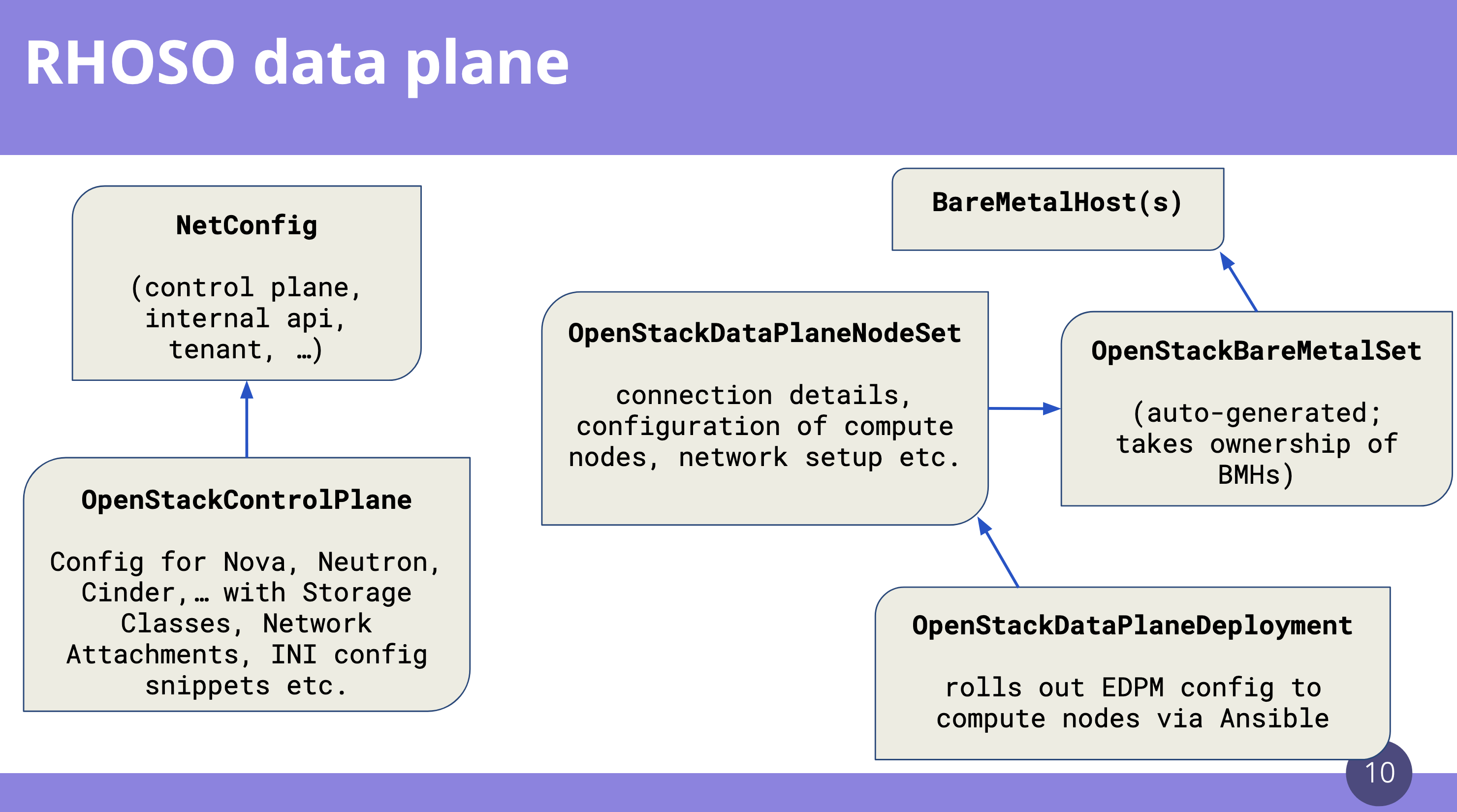
The video recording of our full presentation is now available on YouTube and you can find the slidedeck on the conference website.
Just like last year, where I spoke about CERN’s Scalable and multi-tenant Kubernetes Ingress Infrastructure, the conference and venue were very enjoyable. DevConf.CZ has a unique community spirit that you don’t find everywhere. It’s less about corporate pitches and more about practitioners sharing what they’ve learned in the trenches.
It was also a fantastic opportunity to reconnect with old friends and colleagues from the community and make new connections, whether it was in the hallway track between sessions or at the various community meetups.